
Dudettes, Remixed and Reprogrammed
How Two Guys and a Machine Changed the Shape of the ’80s

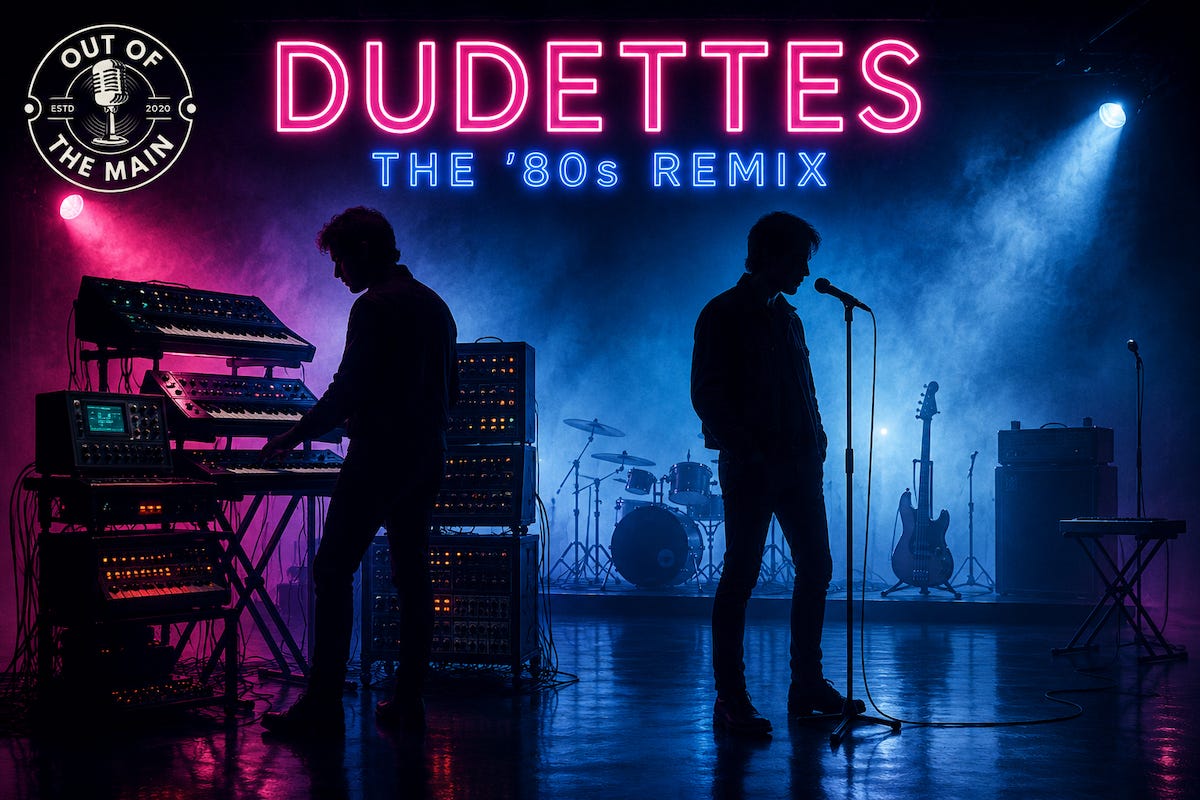
Somewhere along the way, bands got smaller. Not less ambitious. Not less successful. Just…literally smaller.
The 1970s gave us the classic “dudettes”—a term borrowed years ago from Milwaukee Yacht Rock’s John O’Grady to describe the era’s abundance of two-man acts. Think Loggins & Messina. Hall & Oates. Seals & Crofts. England Dan & John Ford Coley. These were partnerships built largely around songwriting, harmony singing, and acoustic instrumentation. Two voices working together toward a common sound.
But by the time the 1980s arrived, something had changed. The dudette survived, but the formula evolved. The folk-inspired duos and singer-songwriter partnerships of the previous decade gave way to a new breed of musical collaboration—one shaped less by guitars and vocal harmonies and more by technology.
What started as a fun exercise in cataloging two-man acts eventually revealed itself as something bigger: the accidental third chapter in a story we’ve been telling all season. First came synthesizers. Then came drum machines. And now, perhaps inevitably, came the musicians who built entire careers around them.
When Technology Changed the Band
One of the most interesting observations from the episode is how dramatically the definition of a “band” changed during the 1980s. Once synthesizers, sequencers, and programmable drum machines became sophisticated enough, musicians no longer needed four or five people in a room to create a full arrangement. A songwriter could generate bass lines, keyboard parts, percussion, and textures that previously required multiple players. The technology didn’t eliminate collaboration, but it fundamentally changed the form that collaboration took.
That’s where the 1980s dudette begins to emerge. Instead of two singer-songwriters standing side by side with acoustic guitars, you often had one person serving as the architect of the music—the programmer, arranger, and sonic visionary—while the other became the primary vocalist, frontman, or public face. The partnership still mattered. In many cases, it mattered more than ever. But the division of labor looked entirely different from what audiences had grown accustomed to during the previous decade.
Interestingly, the conversation also raised a question that never receives much attention: if technology made it possible for one person to create almost everything, why weren’t there more solo artists?
The answer may simply be that great records still benefit from collaboration. A second set of ears. A complementary skill set. Someone willing to challenge an idea before it becomes permanent. Even in an era increasingly defined by machines, the human partnership remained essential.
The Rise of the Synth-Powered Dudette
Once you start looking for them, these acts seem to appear everywhere.
Some were obvious from the beginning: Pet Shop Boys, Erasure, Soft Cell, Naked Eyes, and OMD all fit comfortably into the category.
Others occupied a grayer area. Tears for Fears began life as more of a traditional band before gradually becoming identified almost entirely with Roland Orzabal and Curt Smith. China Crisis, Go West, Wang Chung, and Johnny Hates Jazz followed similar paths, often blurring the line between “band” and “partnership.”
What united many of them wasn’t simply that there were two people involved. It was the way those two people interacted.
Again and again, the same structure emerged: one person driving the creative vision and another serving as the voice, personality, or public-facing half of the operation. Sometimes the split was obvious. Sometimes it was nearly invisible. But once the pattern reveals itself, it’s hard not to see it everywhere throughout the decade.
MTV’s Unintended Influence
The episode never fully settles on whether MTV helped create the phenomenon, but it’s difficult to ignore the possibility that it accelerated it.
Television rewards faces, and many of these acts became visually associated with two recognizable personalities even when additional musicians existed behind the scenes. For many listeners, Tears for Fears wasn’t a band; it was Roland and Curt. Wham! wasn’t a collection of musicians; it was George Michael and Andrew Ridgeley. Pet Shop Boys were Neil Tennant and Chris Lowe. The audience learned the faces long before they learned the personnel credits.
That visual simplification may have mattered more than we realize. As music became increasingly image-driven, the idea of a two-person creative partnership offered something that sat neatly between a traditional band and a solo artist. It provided multiple personalities without the complexity of managing five or six public identities. Whether intentional or not, it became one of the defining visual templates of the decade.
The Real Legacy
What makes these artists fascinating today isn’t simply that they were duos. It’s that they represent a transitional moment in music history.
The technology was changing. Recording methods were changing. The relationship between musicians and instruments was changing. Yet listeners still seemed to crave collaboration, chemistry, and the creative tension that comes from two people working together toward a shared goal.
Viewed through that lens, this episode becomes something more than a catalog of 1980s acts. It’s the logical conclusion of the conversation that began with synthesizers and continued through drum machines. Those episodes explored the tools. This one explored the people who embraced them.
The result was a decade filled with partnerships that existed somewhere between traditional bands and solo artists—acts that could harness the power of new technology without sacrificing the creative spark that comes from collaboration.
In retrospect, the accidental trilogy was there all along. We just hadn’t connected the dots yet.
⚡ The Lightning Round
🌊 Found at Sea
Tom: Julio Iglesias & Willie Nelson – “To All the Girls I’ve Loved Before”
A song Tom once dismissed as pure adult-contemporary fluff now reveals an astonishing collection of studio talent behind the scenes. The personnel list reads like a West Coast All-Star Game: David Foster, Nathan East, Neil Stubenhaus, Carlos Vega, Jerry Hey, Gary Grant, Chuck Findley, Richard Page, Steve George, Richard Marx, and more. Sometimes the liner notes are the real story.
John: Diana Ross – “Swept Away”
A forgotten mid-‘80s hit with a surprising pedigree. Written by Daryl Hall and Sarah Allen, produced by dance-pop pioneer Arthur Baker, and featuring Hall himself on background vocals, it’s a reminder that some of the era’s most interesting connections were hiding in plain sight.
💎 Buried Treasures
John: Glenn Frey – “The One You Love”
A saxophone mystery solved. The famous melodic sax line belongs to Ernie Watts, but the improvisational fade-out is actually performed by Jim Horn. Once you hear the tonal shift, you can’t unhear it.
Tom: Corey Hart – “It Ain’t Enough”
An overlooked gem featuring a quintessentially ’80s sax solo. The surprise? The player is Billy Joel sideman Richie Cannata, whose unmistakable style helps elevate an already stellar track.
🎵 Songs My Wife Hates
John: The Beach Boys – “Sail On, Sailor”
A song John considers a comfort-food classic. A song Mrs. John apparently does not. Opposites attract.
⚓ Final Thought
This episode began as a simple sequel to an old idea. It ended up becoming something more.
The synthesizer episode explored the tools.
The drum machine episode explored the rhythm.
This one explored the people who embraced both and reshaped popular music in the process.
Turns out the accidental trilogy was there all along. You just needed two dudes to point it out.
Born at sea.
Raised on radio.
Still dudettes after 7 seasons of this.
Ahoy, Polloi. ⚓🎶
🔒 The Inner Circle
Beginning with this issue, paid supporters of Out of the Main now have a seat at the table…
Keep reading with a 7-day free trial
Subscribe to Out of the Main to keep reading this post and get 7 days of free access to the full post archives.